Toddler Piano and Music Games
Toddler Piano and Music Games
Toddler Piano fun learning music games for kids
Screenshots


Toddler Piano and Music Games: Fun Musical Learning for Young Children
Toddler Piano and Music Games is an educational app designed to introduce young children aged 1 to 5 to the world of music through interactive play. The app combines a virtual piano with engaging mini-games that teach musical notes, rhythms, and animal sounds. It focuses on fostering creativity, improving hand-eye coordination, and building early cognitive skills in a safe, ad-free environment. The interface features colorful graphics and simple touch controls tailored for small fingers. With no complex menus or text-heavy instructions, children can explore freely. The app also includes parental controls to manage playtime and access settings. Its design prioritizes intuitive interaction, allowing toddlers to produce sounds and melodies instantly. By blending entertainment with learning, the app aims to make music accessible to even the youngest users, turning screen time into a productive and joyful experience.
Chapter 1: Function
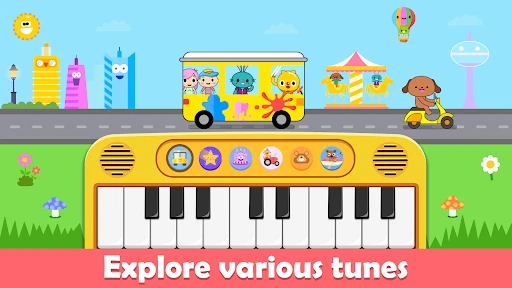
The core functions of Toddler Piano and Music Games revolve around musical exploration and skill-building. First, the app offers a virtual piano with multiple sound options, including classic piano tones, animal noises, and cartoon sound effects. Children can tap colorful keys to create their own melodies, with each key visually highlighted to encourage repetition. Second, it includes rhythm games where kids follow on-screen prompts to tap or shake the device, helping them understand tempo and timing. Third, the app features song-learning modules with simple nursery rhymes, where notes light up in sequence so toddlers can play along. Fourth, a free-play mode allows unrestricted experimentation, with no scoring or time limits to reduce pressure. Fifth, the app incorporates memory games where children match musical sounds to corresponding instruments or animals. All functions are supported by bright animations and positive reinforcement sounds, such as clapping or cheer effects, to maintain engagement. The app operates offline, ensuring uninterrupted play without internet dependency. These features combine to create a multisensory learning tool that builds foundational music skills while keeping activities simple and enjoyable.
Chapter 2: Value
Toddler Piano and Music Games offers significant value by addressing the developmental needs of early childhood through music. Its primary advantage is promoting cognitive growth at a critical learning stage. Research shows that music exposure enhances memory, language processing, and spatial reasoning in toddlers. The app leverages this by integrating pattern recognition and cause-effect relationships into its games. For example, pressing a piano key produces an immediate sound, teaching toddlers that actions have outcomes. This reinforces neural connections in a fun, low-stress manner. Another key value is the development of fine motor skills. The tap-and-drag interactions require precise finger movements, which strengthen hand muscles and improve coordination. The app also nurtures emotional intelligence. Creating music allows children to express feelings non-verbally, offering an outlet for joy or frustration. Parents benefit from the app’s educational focus; it transforms passive screen time into active learning. The ad-free environment eliminates distractions, while parental controls allow customization of volume, sensitivity, and game difficulty. Unlike many other apps, it requires no reading ability, making it inclusive for pre-literate users. Additionally, the app encourages parent-child bonding when used together. A parent can guide a child through a song or join in tapping the piano, turning music into a shared activity. Finally, the app’s offline capability ensures it works during travel or in areas with poor connectivity. By blending joy with learning, it provides a tool that supports holistic development without overwhelming young users.
Chapter 3: Scenarios
Toddler Piano and Music Games is designed for three primary user groups: parents, caregivers, and early childhood educators. The main target is parents of children aged 1 to 5 who seek educational screen time. A common use case is during quiet play at home. For instance, a parent places the app on a tablet while preparing meals, allowing the toddler to explore piano keys safely. The app’s simple interface prevents frustration, and the positive sound effects keep the child engaged independently. Another scenario is during car rides or waiting times at restaurants. Since the app works offline, it becomes a portable entertainment tool that prevents boredom without requiring internet access. The memory games are particularly effective here, as they require focus and can calm an overstimulated child. Caregivers, such as nannies or grandparents, use the app to facilitate music-based activities without needing musical training. They can join in by playing simple duets, reinforcing social interaction. For educators, the app serves as a classroom resource for preschool music lessons. Teachers use the rhythm games to teach tempo during group activities, or assign the animal-sound piano to help children identify different auditory cues. A typical classroom use case involves a teacher demonstrating a nursery rhyme on the virtual piano while children follow along on individual devices. This group learning scenario builds listening skills and cooperation. Additionally, therapists sometimes incorporate the app into music therapy for children with developmental delays, using the gentle sounds to encourage nonverbal communication. The app’s versatility across home, travel, and educational settings ensures it meets diverse needs while keeping children entertained and learning.
Advantages
- turns tapping into musical notes instantly
- animals respond with sounds on key press
- colorful keys match toddlers' visual focus
- no ads during play sessions for kids
- offline mode works without wifi needed
Disadvantages
- limited to preset songs
- no free play
- sound accuracy drops on older devices
- no progress tracking for parents
- screen lock feature missing for active toddlers
- key sizes fixed
- not adjustable for small hands
Frequently Asked Questions
Q: What age group is Toddler Piano designed for?
A: Toddler Piano and Music Games is designed for children aged 1 to 5 years old. The interface uses large, colorful buttons and simple touch interactions suitable for toddlers. No reading skills are required. The app adapts to various developmental stages with adjustable difficulty in music games.
Q: Does the app require any in-app purchases or subscriptions?
A: The app is free to download with basic content. It includes optional one-time in-app purchases to unlock additional instruments, songs, and game modes. No subscription is required. All core piano play and introductory music games are accessible without payment. Ads can be removed via a small purchase.
Q: What devices and systems are supported for this app?
A: Toddler Piano is available on iOS (iPhone and iPad) with iOS 12.0 or later, and on Android devices with Android 5.0 or later. It is optimized for tablets with larger screens but works on phones. No additional equipment like external keyboards is required. The app does not support smart TVs or desktop computers.
Q: Can my child play offline without internet connection?
A: Yes, Toddler Piano and Music Games works fully offline after the initial download. All piano sounds, musical games, and animal sound effects are stored locally. Internet is only needed for downloading the app, processing in-app purchases, or displaying optional ads. No real-time streaming or online features are included.
Q: How to reset progress or unlock content on a new device?
A: Progress and unlocked content are stored locally on each device, not in the cloud. To transfer purchases, use the same Apple or Google account and tap 'Restore Purchases' in the settings menu. To reset progress for a new child, go to Settings > Reset Game Data. No account registration is required for basic use.
Technical Information
Recommended for You

Dungeon Clawler

Truth or Dare - Spicy and Evil

Siralim Ultimate

Spades

Mini Relaxing Game- pop it

Color Up - Color By Number

123 Numbers - Count & Tracing

Zen Word® - Relax Puzzle Game

Drawing Games: Paint And Color

Goods Master 3D: Puzzle Games

UNO!™

Adult Color - Paint by Number

Singing Monsters: Dawn of Fire

Hollywood Crush: Match3 puzzle

Stickman Hook

Ocean Is Home :Island Life Sim

Draw a Stickman: EPIC 2

Prison Escape- Jail Break Game

Crossword Quest

Melon Sandbox

Little Panda's Restaurant
Solitaire

Street Racing 3D
