what3words: Navigation & Maps

what3words: Navigation & Maps
Navigation for adventurers using three word addresses worldwide
Screenshots


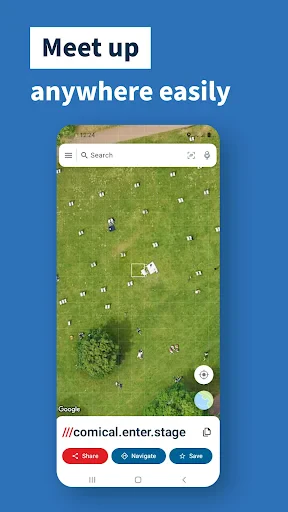

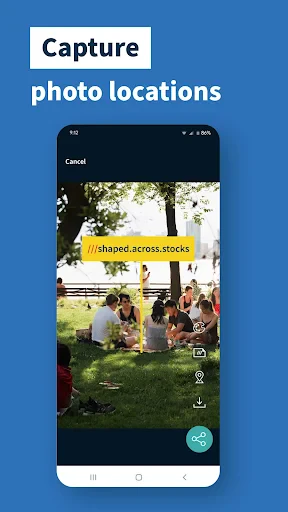
About what3words Navigation & Maps
what3words is a geocoding application that divides the world into a grid of 3-meter by 3-meter squares, assigning each square a unique combination of three words. Unlike traditional addresses or GPS coordinates, this system provides an extremely precise and easy-to-remember location identifier for any point on Earth. The app facilitates navigation, location sharing, and map exploration by converting these three-word addresses into geographic coordinates and vice versa. It serves as a universal addressing system, particularly valuable in areas without formal street addresses, remote locations, or emergency situations where precise location is critical. The app integrates with major navigation platforms and supports offline functionality, making it a versatile tool for personal and professional use.
Chapter 1: Function
The core function of what3words is to simplify and enhance location precision. Users can find any location on the planet by entering a three-word address, such as table.lamp.shade, which corresponds to a specific 3x3 meter square. The app converts these words into latitude and longitude coordinates and displays the location on an integrated map. Conversely, users can drop a pin on the map to obtain the three-word address for that exact spot. A key feature is the ability to share this address via messaging apps, email, or social media, ensuring the recipient can navigate precisely to that square. The app also provides turn-by-turn navigation by sending the coordinates to external map services like Google Maps or Apple Maps. Offline mode allows users to search for and convert three-word addresses without an internet connection, which is crucial in remote areas. Additionally, the app supports multiple languages, enabling users to generate and retrieve three-word addresses in their native tongue.
Chapter 2: Value
what3words offers substantial value by solving the problem of imprecise and complex location identification. Its primary advantage is its unparalleled accuracy, down to a 3-meter square, eliminating the ambiguity of traditional street addresses or the complexity of long decimal coordinates. This precision is transformative for emergency services, allowing callers to quickly and accurately report their location, potentially saving lives in situations where every second counts. For logistics and e-commerce, the app ensures deliveries reach exact drop-off points rather than approximate building locations, reducing failed deliveries and improving customer satisfaction. It also empowers individuals in rural or developing regions where formal addressing is absent, enabling them to receive mail, goods, or services. The system’s simplicity, using only three common words, makes it accessible to anyone, regardless of language or technical literacy. Furthermore, the offline capability ensures reliability in areas with poor connectivity, and its integration with major navigation platforms means users can instantly route to any three-word address. For travelers, what3words simplifies meeting points, event locations, and exploration of unfamiliar terrain, reducing confusion and frustration.
Chapter 3: Scenarios
The primary target users of what3words include emergency responders, logistics professionals, travelers, and individuals in underserved areas. In emergency scenarios, a hiker lost in a national park can share their three-word address with rescue teams, who can then locate them within meters. Delivery drivers use the app to find exact entrances to warehouses, construction sites, or remote properties, avoiding ambiguous addresses. Travelers rely on it to pinpoint meeting spots at large venues like music festivals or sports stadiums, where conventional landmarks are insufficient. In humanitarian contexts, aid organizations employ what3words to coordinate resource distribution in refugee camps or disaster zones lacking formal infrastructure. Real estate agents and property managers use the system to describe remote plots of land or buildings without street addresses. Additionally, event planners integrate three-word addresses into invitations for weddings or corporate retreats held in outdoor locations. The app also serves outdoor enthusiasts, such as geocachers or off-road drivers, who need to log exact locations for future reference. By providing a consistent, precise, and simple location system, what3words addresses a wide range of everyday and critical use cases across both consumer and enterprise sectors.
Advantages
- splits world into 3m squares with 3-word codes
- works offline without cell signal or data
- pinpoints precise entrances like back gates or fields
- supports voice entry for hands-free location sharing
- integrates with car navigation and ride-hailing apps
Disadvantages
- requires memorizing word trios instead of addresses
- no standard street map view for visual orientation
- fails if user misspells any of the three words
- limited coverage in rural areas with sparse grids
- subscription needed for bulk geocoding of multiple points
Frequently Asked Questions
Q: What is what3words and how does it work?
A: what3words is a navigation and mapping app that divides the world into 3-meter squares, each assigned a unique three-word address. Instead of using traditional street addresses or coordinates, you can share or navigate to any precise location using three words. It works offline via GPS and requires no data connection for conversion, making it reliable in remote areas. The app integrates with Google Maps and other platforms for turn-by-turn directions.
Q: Is the app free to use or are there in-app purchases?
A: The app is free to download and use for basic functions like finding, sharing, and navigating to three-word addresses. Premium features, such as voice navigation, offline map downloads, and multiple address grid overlays, require a subscription. There is no one-time purchase option. Users can try the premium tier with a free trial period before committing to a paid plan.
Q: Does what3words work on all devices and systems?
A: what3words is available on iOS and Android devices with support for smartphones and tablets. The app requires at least iOS 13.0 or Android 6.0 and above. It works optimally with GPS enabled for accurate location detection. Compatibility with older devices is limited by OS requirements. The offline mode functions on any device with sufficient storage for map data downloads.
Q: How accurate is what3words for navigation?
A: The app provides 3-meter accuracy for any location on Earth, covering land, oceans, and ice caps. However, navigation accuracy depends on the device's GPS signal strength. In dense urban areas or indoors, GPS drift may reduce precision. The three-word addresses are fixed and do not change, ensuring consistent pinpointing. For driving directions, the app uses third-party mapping services, which may have route inaccuracies.
Q: Can I use what3words without an internet connection?
A: Yes, the core conversion of three-word addresses to GPS coordinates works offline without data signal. However, map display, voice navigation, and real-time traffic updates require an internet connection. You must download offline maps for the area beforehand in the premium version. The app does not provide emergency services location sharing offline unless the device has cellular network access for sending the address.
Technical Information
Recommended for You

DramaWave - Drama Shorts&Reels
9Weather: Weather forecast

HomeWAV

National Car Rental

Play Disney Parks

Denver Broncos

KIDSTOPIA - Learning and Play

Planes Live - Flight Tracker

SplashLearn: Kids Learning App

Google Sheets

MyMoney Pro - Expense & Budget

Jooble — Job Search App

Our Daily Bread

Weather Live Wallpapers

FreePrints

Skincare Routine

BimmerLink for BMW and MINI

NBC LA: News, Weather

Books - Read and Download

WoAD

My BMW

PractiScore Competitor

HamStudy.org