Duolingo: Language Lessons

Duolingo: Language Lessons
Learn languages fast with fun games for all levels
Screenshots



Duolingo: Language Lessons – A Gamified Path to Multilingual Mastery
Duolingo: Language Lessons is a widely used educational application designed to make language learning accessible, engaging, and effective for a global audience. Available on both Google Play and the Apple App Store, the platform transforms the traditional study process into a series of bite-sized, game-like lessons. It covers over 30 languages, from widely spoken ones like Spanish, French, and Japanese to less commonly studied languages such as Navajo or Hawaiian. The app employs a structured curriculum that combines reading, writing, listening, and speaking exercises, leveraging artificial intelligence to adapt to the user's learning pace. With a clear focus on building vocabulary and foundational grammar, Duolingo aims to guide users from absolute beginner to intermediate conversational proficiency. Its freemium model, featuring optional premium subscriptions to remove advertisements and provide offline access, has contributed to its status as one of the most downloaded and recognized language learning tools worldwide.
Chapter 1: Function
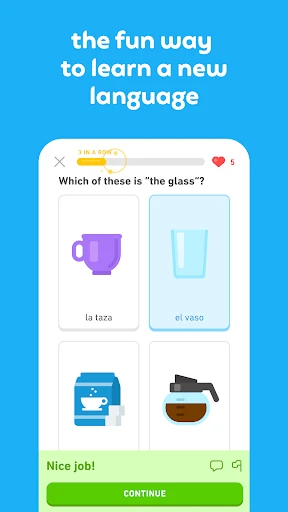
The core functionality of Duolingo centers on its structured, gamified lesson system. Each language course is divided into thematic units, such as Greetings, Food, or Travel, which contain a series of individual lessons. A typical lesson involves a sequence of interactive exercises, including translating sentences, matching words to images, fill-in-the-blank prompts, and speaking exercises that utilize speech recognition technology to check pronunciation. The app employs a skill tree structure, where users must complete lessons in a progressive order to unlock content. A key functional element is the gamification layer: users earn experience points (XP) for completing lessons, maintain a daily streak to encourage consistency, and receive virtual currency called Lingots or Gems. This currency can be spent in the in-app shop to purchase power-ups, such as Streak Freezes or Timer Boosts. Duolingo also recently integrated an AI-powered feature called Duolingo Max, which provides explanations for incorrect answers and enables simulated role-playing conversations. This combination of structured curriculum delivery and motivational game mechanics defines the application’s primary function as a habit-building tool for language acquisition.
Chapter 2: Value
Duolingo’s primary value proposition lies in its ability to lower the barrier to starting and maintaining language study. The app’s key advantage is its convenience; lessons are designed to be completed in under 10 minutes, allowing users to integrate language practice into a daily commute, a break, or before sleep. This bite-sized approach reduces the intimidation factor of learning a new language and fosters a consistent routine. Furthermore, the gamification mechanics are not merely decorative but serve as powerful psychological drivers. The daily streak creates a sense of obligation and accomplishment, the XP system provides immediate feedback and rewards effort, and the competitive leagues add a layer of social motivation. This model effectively addresses the common problem of low learner motivation and high dropout rates. Another significant advantage is its accessibility. The app is free to use with minimal limitations, making high-quality language education available to anyone with a smartphone. The curriculum, while not leading to fluency, is scientifically designed to build a strong foundation of approximately 2,000 to 3,000 core vocabulary words and basic grammar structures for most courses. For intermediate learners, the addition of stories, podcasts (for some languages), and the AI-powered explanations in the premium tier offer deeper context and explanations. Ultimately, Duolingo’s value is as a consistent, low-friction, and reliable starting point for millions of people who otherwise would not engage with language learning, providing a clear return on investment in terms of time and effort.
Chapter 3: Scenarios
Duolingo serves a diverse range of users, but its primary target groups are casual learners, travelers, and students supplementing formal education. A typical user is an adult professional with a busy schedule who wishes to learn a new language for an upcoming vacation or to maintain cognitive health. For this group, the app’s 5-minute lesson format is ideal for fitting into breaks or commutes. Another prominent user group is high school or college students who use Duolingo as a supplementary tool alongside their formal language classes. The app’s structured skill tree reinforces vocabulary and grammar taught in a classroom, while the game elements provide a study method that feels less like chore and more like play. A third key scenario involves expatriates or immigrants attempting to learn the basics of their new country’s language to navigate daily tasks like ordering food, asking for directions, or basic social interaction. Duolingo’s emphasis on spoken practice and common phrases directly supports these real-world needs. Additionally, the app is used by retired individuals looking to engage in lifelong learning and by parents who want to introduce a foreign language to their children in a fun, low-pressure environment. In all these cases, the app provides a private, judgment-free, and self-paced environment for skill development, making it a versatile tool for anyone motivated to start their language learning journey.
Advantages
- gamified streaks and xp system improve daily consistency
- uses spaced repetition to reinforce vocabulary retention
- offers bite-sized 5-minute lessons for on-the-go use
- speech recognition enables basic pronunciation feedback
- community leagues add light social competition
Disadvantages
- advanced grammar and cultural context are minimally covered
- speech recognition struggles with non-native accents
- hearts system limits practice without subscription
- unit progression feels slow for intermediate learners
- offline mode requires premium subscription
Frequently Asked Questions
Q: What is Duolingo and how does it teach languages?
A: Duolingo is a gamified language-learning app offering courses in over 40 languages. It uses short, interactive lessons covering reading, writing, listening, and speaking. Core features include adaptive learning paths, streak rewards, leaderboards, and personalized reminders. Lessons are structured as bite-sized exercises, and progress is tracked with XP points and skill trees. No prior knowledge required to start.
Q: Is Duolingo free to use or does it require in-app purchases?
A: Duolingo is free to download and use. It offers optional in-app purchases for Duolingo Plus (now Super Duolingo), which removes ads, provides unlimited hearts (lives), and offline access. A free tier includes ads and a limited number of hearts that regenerate over time. No additional equipment is needed beyond a smartphone or computer with internet access.
Q: Does Duolingo work on both iOS and Android devices?
A: Yes, Duolingo is available for iOS, Android, and web browsers. The mobile app requires iOS 15.0 or later (iPhone, iPad) and Android 8.0 or later. It supports multiple languages and is designed for learners of all ages, though children under 13 should use the Duolingo Kids app. Offline features require Super Duolingo subscription.
Q: How far can I progress in a language with Duolingo?
A: Duolingo's curriculum covers up to an intermediate (B1/B2 on CEFR scale) level for most major languages, with focus on vocabulary and grammar basics. It lacks advanced conversation practice or real-world fluency. The app is best as a starter tool or supplementary resource. Users seeking mastery should combine Duolingo with immersion, speaking practice, and other materials.
Q: Can I use Duolingo without an internet connection?
A: Duolingo requires an internet connection for the free version. Offline access is only available with a Super Duolingo subscription. With Super, you can download specific course sections (e.g., individual skills) to your device. Progress syncs when you reconnect. The web version does not support offline use. No other permissions or hardware are needed beyond standard storage access.
Technical Information
Recommended for You

maxim — order a taxi & food

Local Now: News, Movies & TV

Infinite Design

Dress Up Royal Princess Doll

Madison Reed App - Hair Color

@Voice Premium License

Lezhin Comics -การ์ตูนและนิยาย

NOAA Weather Unofficial

HD Camera 2025 for Android

iTunes

Launcher iOS16 - iLauncher

DeerCast: Weather, Maps, Track

Goal Horn Hub

SODA - Natural Beauty Camera

Visible mobile

OpenDocument Reader Pro

MangaGo - Ultimate Manga App

Vacasa - Vacation Rentals

Live Street view 360

Webex Meetings

PolyBuzz: Chat with AI Friends

MyHealthONE

Neon Clock Wallpaper
